Tidy Survival Analysis
An applied guide in R
Tidy Survival Analysis
Learn survival analysis in R—and turn your results into clear figures and polished tables with tidy tools. Follow a reproducible workflow from data preparation and modeling to reporting.
ONE DATASET. CLEAR FIGURES AND TABLES.
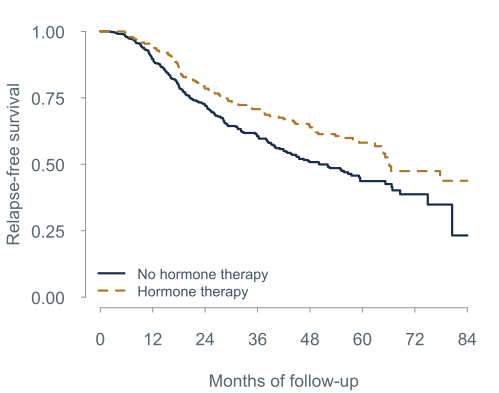
Survival curves show the pattern over time. Regression tables make the model’s estimates easy to read.
A model, ready to report
| Characteristic | HR | 95% CI |
|---|---|---|
| Hormone therapy: yes vs no | 0.70 | 0.54–0.90 |
| Age: per 10 years | 0.92 | 0.76–1.10 |
| Tumor size: per 10 mm | 1.17 | 1.09–1.25 |
Selected adjusted Cox estimates · HR = hazard ratio; CI = confidence interval. From the Chapter 1 example, with 686 patients and 299 events; interpretation and model checks accompany the analysis.
Where to begin
A little R is enough to start. Survival concepts are introduced through examples, and the tidyverse is explained from the beginning.
How to use this book
Read alongside the R examples, try the exercises, and use the companion slides to revisit the main ideas. Code and data are available to download.
The chapters
01
Survival Analysis in Base R
Censoring, survival curves, regression, prediction, and diagnostics using the standard survival package.
02
Working with Tidy Survival Data
Meet the tidyverse. Prepare survival data, visualize follow-up, and build a descriptive table.
03
Nonparametric Estimation
Turn survival estimates and competing-risk analyses into clear tables and graphics.
Companion slides & code · narrative chapter forthcoming
04
Regression Models
Tidy Cox and Fine–Gray model results, communicate associations, and examine model assumptions.
Companion slides & code · narrative chapter forthcoming
05
Machine Learning
Build and evaluate survival prediction models with tidymodels and censored.
Companion slides & code · narrative chapter forthcoming
These materials grew out of my short course taught at the 2025 Joint Statistical Meetings. The original slides remain available as companions to the developing text. Find the code, data, and slides →